

I grew up knowing about Gloria Steinem the way I knew about the Statue of Liberty or Queen Esther or Jo March — a divine and righteous force that was a beacon for progress and a radical symbol of female grit.
I used to stare at her picture on the cover of my mother’s copy of Outrageous Acts and Everyday Rebellions, a beatific presence, glasses-smart and radiating joy. My mother, a feminist vanguard who was in the first class of women admitted to Brown in the 1970s and was one of the first female doctors to graduate her residency program at Columbia Medical School, brought her up often.
In my earliest understanding of the cultural icon who died yesterday at 92 years old, a woman named Gloria Steinem was why my mom could see her patients during the day and be home at night to cook us dinner and tuck us into bed. A woman named Gloria Steinem was why, in second grade, it was important I tell Noah Blumberg (allllmost his real name) that I could absolutely join the chess club after school. A woman named Gloria Steinem was why I should be allowed to wear pants to Yom Kippur services if my tights were too damned itchy.
I remember, in seventh or eighth grade, flipping to the “Feminist Revolution” chapter in my New-York-State-approved history textbook, and seeing the black and white picture of an adult woman dressed as a rabbit. It took me a moment to reconcile the 1980s Cool Aunt Gloria from my mother’s books with the model in the leotard and bunny ears.
“Oh,” I realized. “You can be smart and brave and also very hot.”
I clung to this notion when, my freshman year of college, I purchased a neon American Apparel body suit for a party called “Tight and Bright.”
“Just like Gloria,” I told myself as I shook my fluorescent green ass to Flo Rida in a sweaty off-campus house, “I am a feminist icon.” (It bears saying: It was only when I actually took a series of Women’s Studies courses that I realized I had missed the entire point. Perhaps if I had been writing an anthropological takedown of campus misogyny instead of trying to hook up with a guy named Trey (real name), the leotard would have better honored her legacy.)
Nevertheless, like many women raised by women who were radicalized by Gloria Steinem’s radical acts of the 1960s and 70s and beyond, I thought of her as a God who was part of my family. She was why my mother was able to be the way she was. She was an understanding between women who wouldn’t be intimidated or infantilized by men. To me, and to the millions of people who mourn her today, she was the coolest woman who ever lived and any time I did anything that felt cool it was because it reminded me of her.
This April, two decades and many of my own personal and professional feminist reckonings after the leotard party, I found myself invited to Gloria Steinem’s house for a talking circle about book bans. I read the email from Gayle Forman, a founding member on the board of an organization I love called Authors Against Book Bans, several times to make sure I hadn’t misconstrued it. When it was clear that I was, in reality, being summoned to the private home of Gloria Steinem I started to cry and called my mom.
“Of course you are,” she said, barely believing it herself, “It’s only right.”
On the day of the event, I texted my sister and best friends and one professional fashion editor several different outfit choices, got on the train, and headed uptown to Gloria’s.
Her townhouse, a century-old brownstone on a leafy block, was a feminist Shangri-La — a grand, bohemian haven teeming with all the artifacts of a triumphant activist life. The walls were covered in bookshelves and framed mementoes and photographs and protest posters and art. On the parlor floor, a cavernous study gave way to a sun-dappled living room meant for gathering — a large coffee table stacked with books and objects collected from decades of globetrotting, surrounded by a green velvet sofa and upholstered chairs and overstuffed ottomans. The kitchen was a tiny afterthought off a pass-through corridor, the countertop stocked with wine and Pellegrino.
Milling around the living room before the event, among the collegial and merry chatter of almost entirely women, my brain began to RETAIN as much as it could. This is the coaster on Gloria Steinem’s end table. This is Gloria Steinem’s throw blanket. This is the vase where Gloria Steinem puts her flowers. I saw her from behind, seated in a red overstuffed chair I recognized from pictures on the internet. The celestial center of everyone’s orbit, a queen in her throne.
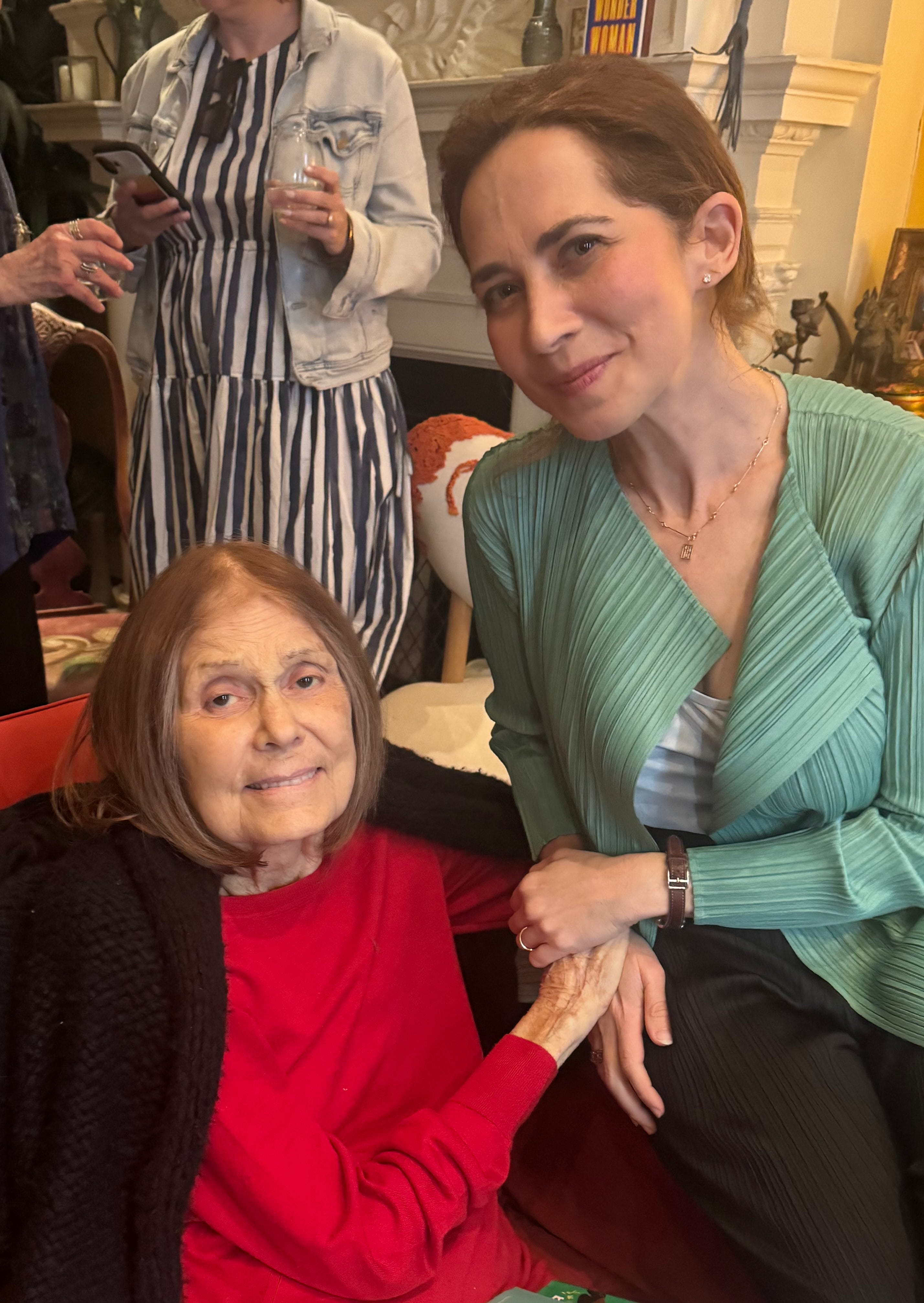
Gayle Forman found me and took me by the arm and brought me up to Gloria Steinem. She was wearing a bright red sweater and her hair was in a neat bob. She was radiant.
I disassociated and Gloria smiled graciously as Gayle talked about my congressional testimony about book bans, and a few of my professional credentials. I had brought a signed copy of my book to give to Gloria, which immediately felt asinine, but before I could discretely drop it between my leg and the chair, Gloria took it from my hand. She flipped to the author bio. Her eyebrow arched. Gayle kept on with the generous introduction, and I blurted out as normal a “Thank you for everything, it means everything to all of us,” as I could muster.
Gloria stopped me politely — a skill probably shared with the Dalai Llama and Beyoncé. She pulled me to her side. I perched on the arm of her chair. Her hand, strong like my grandmother’s because of her age and what it had held, gripped mine.
We began to have as close to a conversation as I could reasonably have with Gloria Steinem.
“I had a stint as a comedy writer, too.” She said, smirking, pointing to the part of my author bio that mentions it. My hand was in her hand. She told me about writing for the satirical news show That Was the Week That Was in 1965. She talked about the writer’s room, and how much of a ride it was to digest the news through comedy, and about the sign on her office door. I told her how different it was by the time I worked in late night, how my bosses were all women — the show has a female head writer and was run by an all-woman team of producers. She told me about an American Indian word for laughter, and how it was similar to possession — that a true laugh is the only involuntary sound a human makes.
She was sharp and funny and generous and she blew my mind. She asked me about my book, and my experience being banned from an event in Montana, and I told her the truth I’m not really supposed to tell and have talked around on press tours: Buffalo Fluffalo is a book about toxic masculinity. She tucked it under her arm and smiled at me. She talked about observing young children play, and I nodded my head in a way that felt almost normal except for the fact that my teeth clanked together. I thanked her repeatedly. Gayle took a picture of us. I went downstairs to her bathroom and called my mother. “Gloria Steinem talked to me,” I told her, breathless. She laughed. “Good. Listen.”
The talking circle she hosted was a ceremony. Women gathered together to share experiences with book bans, led by the magnificent author and activist and friend Maggie Tokuda-Hall. The conversation was galvanizing, and the cause felt urgent but attackable. Granular plans were made — here are the contentious school board elections, here are the city councils in the balance, here are the libraries, here are the librarians on our side. All the while, Gloria listened, engaged, seemingly pleased by this group and these stories of fights to be fought.
It was the end of her life, and she was listening to what would happen next. Her interest, as it has always been, was the progress to be made. She was bringing us together to say out loud and to promise to her that we would carry on. After the discussion, Gloria addressed the group. She spoke about the current administration and her experience with government censorship. She didn’t preach, and she could have preached — she is a central authority on fighting a culture that silences voices. She expressed her gratitude, and spoke about the battles ahead. She wasn’t giving us her blessing so much as she was giving us marching orders.
I left that night and walked down her block and into Central Park. It was an absurdly gorgeous New York City spring evening, the pink confetti from cherry blossoms swirling everywhere and sticking to the footpaths. I sat down on a wood bench to jot down everything I remembered — the mug on her counter, her loud laugh, the way her hand felt, smooth and strong in mine. I closed my notebook and I knew two things to be true: I would almost certainly never be in Gloria Steinem’s house again, and I would never leave.
Thank you, Bess, for sharing your wonderful evening with Gloria. I've been thinking about how she must've known she was leaving the world in the midst of yet-another fight for women. And that's made me so sad. Your essay made me feel better.
P.S. It's thanks to Gloria that, as a kid, I knocked my neighbor Bobby to the ground and sat on him after he derisively called friend Ann and me "just girls." We didn't let him up until he said "uncle."
Bess! Thank you for sharing that beautifully written story! Wow, what a woman’s woman she was! Lucky girl to have had that. Because of her, and our mothers, we learned we had lives we could call our own! Keep at it Bess!🙌💜💜💜